Latvian alphabet
| 1 | 2 | 3 | 4 | 5 | 6 | 7 | 8 | 9 |
|---|---|---|---|---|---|---|---|---|
| A | Ā | B | C | Č | D | E | Ē | F |
| G | Ģ | H | I | Ī | J | K | Ķ | L |
| Ļ | M | N | Ņ | O | P | R | S | Š |
| T | U | Ū | V | Z | Ž |
Latin alphabet
| 1 | 2 | 3 | 4 | 5 | 6 | 7 | 8 | 9 |
|---|---|---|---|---|---|---|---|---|
| A | B | C | D | E | F | G | H | I |
| J | K | L | M | N | O | P | Q | R |
| S | T | U | V | W | X | Y | Z |
The significance of a person's birth details in numerology
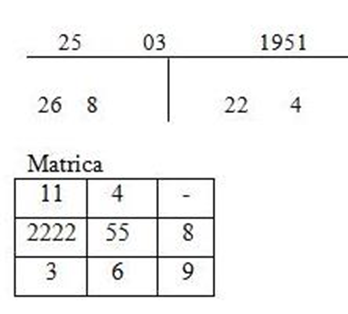
Day, month and year of birth

Next, let us explore what information a person's birth details reveal about them.
The Past section covers the period from birth to approximately age 36. During this time, a person lives with the energy and values they brought into this world. At the same time, they grow and develop in this environment and learn to fit into the rhythm of life. While trying to understand and master the rules and opportunities of their particular environment, they are dependent on the norms imposed by society. We can hardly say that what they do is entirely their own free choice. From birth, a child depends on parents, grandparents, teachers, lecturers, employers and the rules established by society, and, for a certain time, on their own young children as well. It is therefore difficult to say that people can freely do whatever they want until approximately age 36. They are more of a follower than a decision-maker. Between the ages of 28 and 36, a person's values change for the first time. This means that the values that were important until then become less important, while other values crystallize and become priorities. The first generational disagreements also begin to emerge around this age. From birth to approximately age 36, the physical body plays the leading role, meaning a person's actions and ability to achieve their goals. From age 37 to approximately age 72, the emotional body plays the leading role, and people live for themselves. After age 72, the mental body takes the leading role, and people live to pass on the wisdom gained during their lifetime to society and the younger generation. Generational disagreements therefore arise precisely because of this principle: around the ages of 36 and 72, a person's values and priorities change. Those around them who are unaware of this natural cycle are puzzled about what is happening to the person and why they behave so differently in familiar circumstances. The digits in the Past section of the birth details show which values will dominate a person's life until age 36.
The Future section indicates a person's main priorities after age 36. The digits in this section indicate what the person will want to achieve independently and which part of society they will join. The Future digits are analyzed together with the Present digits.
The Present section's digits indicate a person's dominant character traits. These are the traits they use to achieve their goals. These qualities will manifest to a greater or lesser extent throughout their life.
People themselves also perceive the world in three parts: Myself, Me and those closest to me, Me and society; or alternatively, Me, Me and Nature, Me and the Universe. The structure of human life is arranged so that a person can move forward once each level has been understood and the lessons required at that level have been learned. It is just like school: first primary school, then lower secondary school, and finally upper secondary school. Whether to pursue further education is up to each individual. The same applies in life, where people must first learn to understand that they are who they are and others are who they are. Each person has their own DNA code, and likewise each person has their own behavioral and motivational code, which they receive at birth. This information is recorded in the digits of their day, month and year of birth. You may want to object and say that you know people who were born on the same day, or are twins, yet their lives are different. If we called people by the digits of their birth details and also represented the names of the places where they live with digits, many people's lives would be similar. However, as long as we give people an additional code besides their birth details, which we call a first name and surname, their life stories will differ.
Below is an explanation of what makes up a person's individual code.
- Day of birth – The character traits that people around us see in us, but this does not necessarily mean that this is who we are. We simply behave that way.
- Month of birth – The motivation behind our behavior. An emotional state that allows us to feel valued and needed.
- Year of birth – The people we choose as friends because their values in life match our own. The digits that make up the year show the character traits we want to see in the people around us. We can choose our friends, but relatives are relatives, so good relationships with family members do not always develop. This is particularly noticeable during the school years.
- A person's first name – it has two meanings in a person's life. The first is how the person lives and feels with their given name (this depends on whether the digits of their name are in harmony or disharmony with their birth details). The second meaning is how the surrounding society perceives and responds to the sound vibrations of this name, because society does not know the person themselves but perceives the sound of the name, which, like any other sound, evokes feelings and emotions. That is why we often hear people say that those who share a particular name are almost all alike in character or behavior. However, this is only a superficial judgment.
- A person's surname – gives the person the inherited energy of their family line, which has been developed and nurtured from generation to generation. Usually, a person possesses this family line's strongest positive and negative traits to a greater degree.
- Energy level – Indicates the dominant core values in a person's life. It is the prism of values through which people view the outside world and determine their priorities in life. The greater the difference in energy levels between two or more people, the fewer interests they share and the more their worldviews differ.
Numerology matrix.
The number of digits in each cell of the numerology matrix determines how much of the energy associated with that particular digit a person possesses. (For example: cell 1 – leadership traits, cell 2 – potential for patience, cell 3 – how quickly a person can absorb information, etc.)
All digits obtained when determining the Past, Present and Future digits are entered into the matrix (except for the energy level digits).